Simultaneous translation, speech to speech, in real time
AI simultaneous translation: somebody speaks and the audience hears it in their own language a few seconds later, as speech and not only as subtitles. Simultaneous interpretation with no booth, no headsets to hand out and nothing to install.
A room where this happens every week
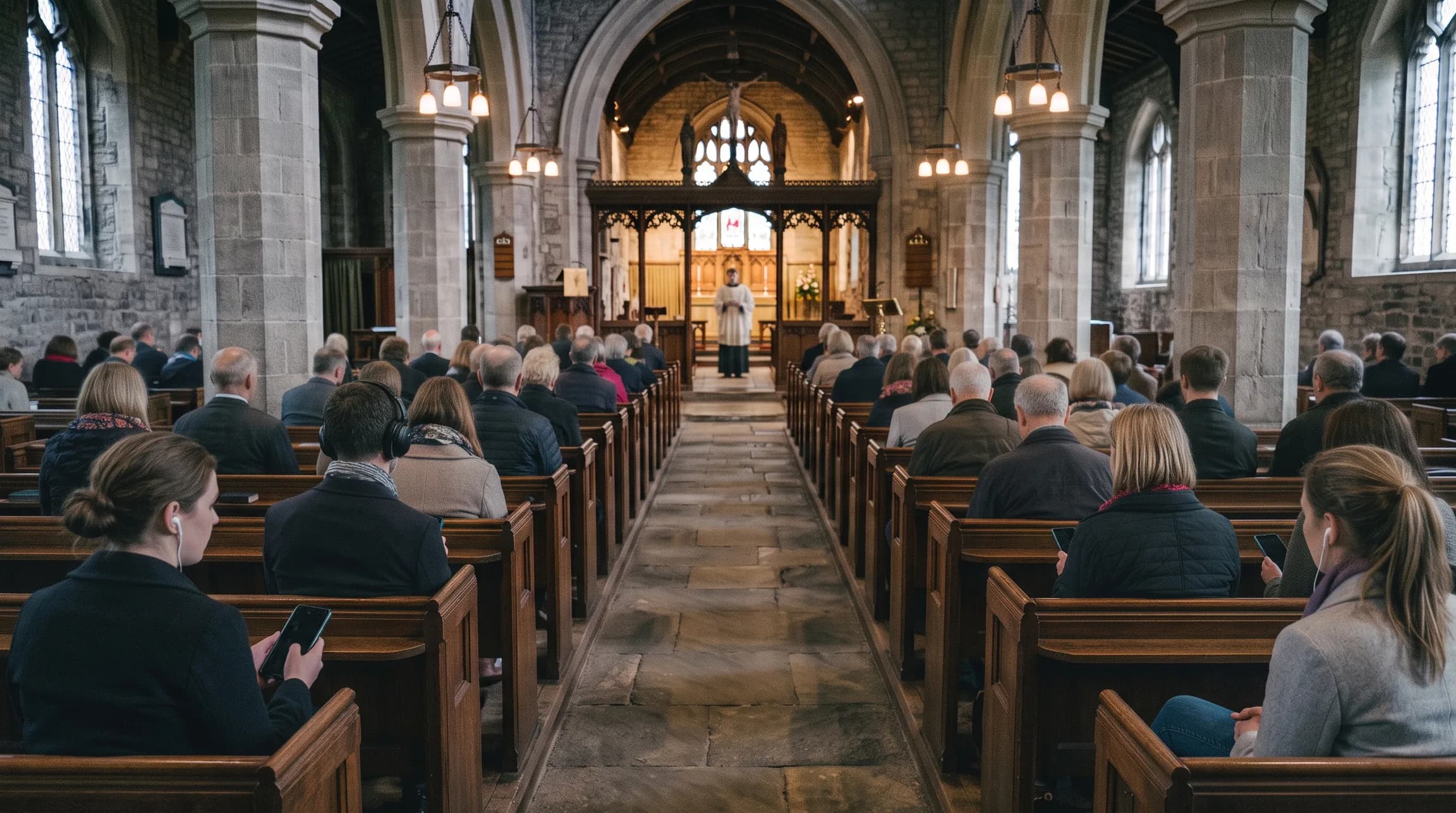
Anyone who does not speak Spanish opens a link on their phone, picks a language and follows the service. Over five hours at a stretch, in one of the most hostile acoustic environments there is.
- Fifteen languages
- You pay for speech, not silence
- No monthly fee
Who this is for
A parish whose Sunday congregation no longer shares one language. A conference that cannot afford a booth and two interpreters per language. A council meeting that has to be followed by people who moved here last year. Anywhere somebody talks to a room and part of the room is missing it.
How it works
- 1
The sound of the room reaches us. A small device on the lectern sends it over SRT, or whatever you already broadcast with sends it over RTMP.
- 2
The engine listens, works out what is being said and translates it while the sentence is still in the air.
- 3
A synthetic voice speaks it in each language, and the audience hears it through a link they opened on their own phone.
- 4
You watch it from your panel: which rooms are live, how long they have run and what that has cost.
What you get
- Fifteen languages at the same time, out of the same audio.
- Under a second from the sentence ending to the voice starting.
- Nothing to install for whoever is listening: a link, or a QR on the wall.
- Your own rooms, created and paused from a panel or from the API.
- Nothing recorded. The audio is translated as it passes and is not kept.
- Credentials per room, so a device that is lost does not open the rest.
Worth knowing: The room needs a usable microphone. Translation can only be as good as what it hears, and a phone at the back of a nave picks up the nave rather than the speaker — the single biggest difference in quality comes from the microphone, not from us.
What it costs
2 credits per spoken minute, per language
You pay for speech, not for how long the event runs: an hour with twenty minutes of voice uses twenty minutes. And every language counts, the one being spoken included — a room in Spanish heard in English, French and German is four. If you only want the subtitles, without sending the voice anywhere, it is 1.25 credits per spoken minute and it does not multiply per language.
See the packsQuestions
- Does the audience need an app?
- No. They open a link in the browser they already have and choose their language. A QR at the entrance is usually enough.
- How long is the delay?
- Under a second from the moment a sentence ends. It is not word by word: the engine waits for the sentence to finish, because translating half a sentence produces the wrong half.
- Is anything recorded?
- The audio, never: it is translated as it passes and nothing of it remains. The text only if you turn keeping on, and then it is fifteen days. If you want a recording transcribed, that is another service and you send us the file.
- What do I need in the room?
- A microphone that hears the speaker and a way to send us the sound: the small device that sends over SRT, or whatever you already broadcast with over RTMP.
- What if the internet drops?
- The room reconnects on its own and carries on. What was said during the gap is lost — there is no way around that — but nobody has to restart anything.
Where people use it
The same engine in very different rooms. Each of these says how it is set up there, where the audio comes from, and where its own limit is.
And what it is usually compared with
Three honest comparisons, each of them saying what the other option does better.
The words only used in your house
An organisation's own names — people, streets, references, job titles — are exactly what a general model has never heard, and where it fails: it swaps them for an ordinary word that sounds similar. Write them once and they stop failing. You write them in the room and they hold for all its meetings.
- It is a list, not training: you write it and it works from the first sentence.
- It collects nothing. Not your audio, not your text, not one second of anything.
- And it is included. Not an extra plan, not a line on the bill.
Try it on something real
The welcome trial is more than enough to sit in your own room, with your own microphone, and hear whether it works for you.
Get startedTranslating is optional
A room can translate, subtitle, or do both. What never happens is the same sentence being translated and subtitled: it is translated when there is somebody to translate for, and subtitled when there is not.
Subtitling without translating costs 1.25 credits per spoken minute and does not multiply per language, because what you see is what is said. And it is decided sentence by sentence: turn translation on halfway through and what came before still counts as subtitles.
Subtitles are always seen in the meeting, kept or not. Keeping is a different thing and the account decides it, not the meeting: what is said is kept for fifteen days and then destroyed.
Translate
COMES WITH THE TEXT
Text
TURNS ITSELF ON
Voice and text, and the minutes when you are done.
No text, no minutes: the room isn’t created.
Translating already brings the text
You cannot translate without first recognising what is said, so a room that translates is already producing the text. It is not a separate product: it comes with the translation.
And you can subtitle without translating
That is the council meeting held entirely in one language: there is nobody to translate for, and the text is needed all the same. And also the room that translates and where, today, everybody speaks the same — with both switched on it subtitles while they share a language, and moves to translating on its own the moment somebody else walks in.
What you cannot do is keep it with neither
No text, no minutes, and it is refused rather than leaving you a room that says it keeps and keeps nothing.
Besides translating
Translating is what happens while people speak. This is what happens around it, and it comes out of the same minutes: no separate plan, no new bill.
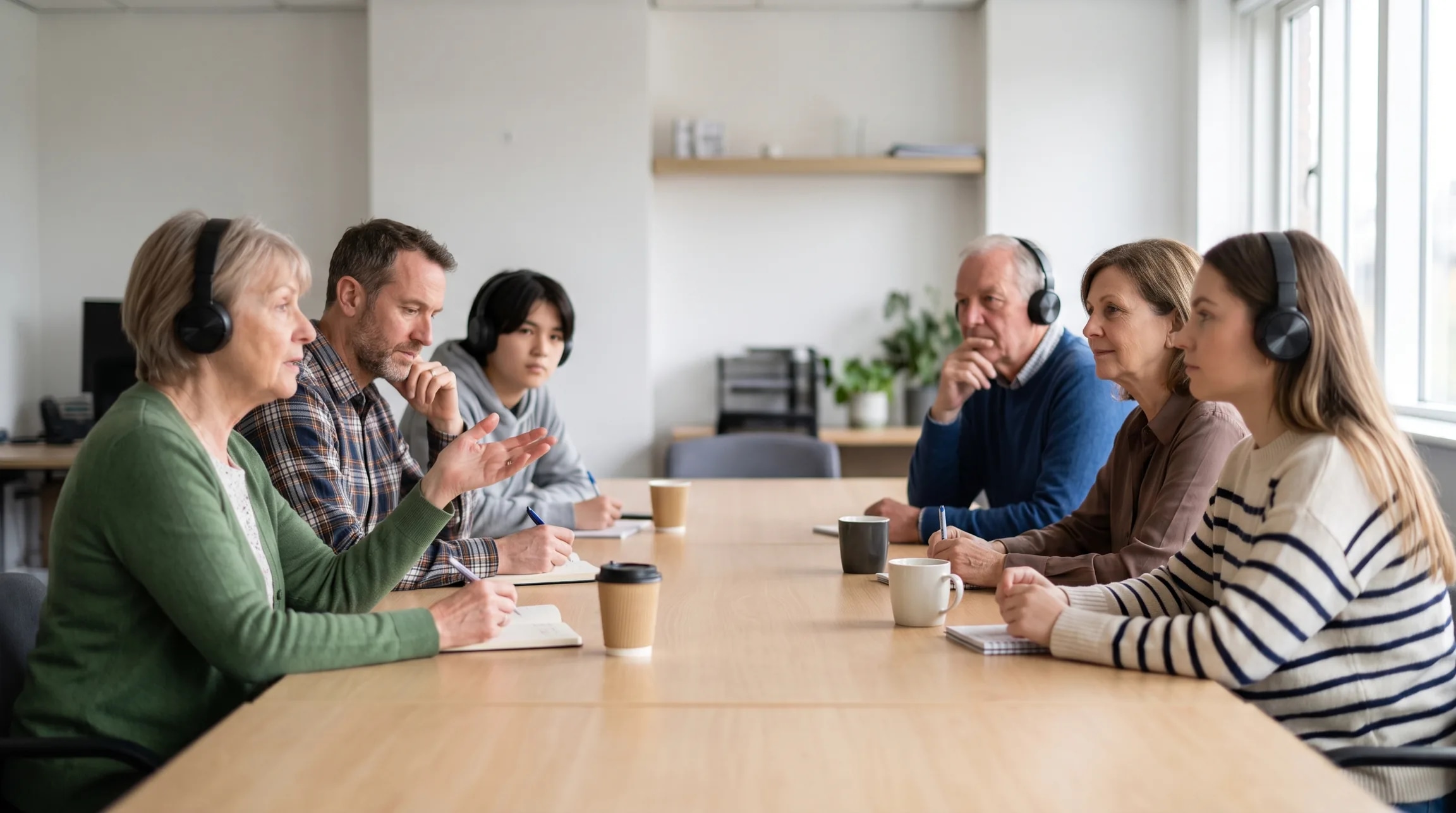
The notes, when it ends
A document with what was decided, who takes each task and the minute it was said. It joins the queue when the room closes and reaches you by email.
The words of your house
The names only used here: people, streets, references. Written once, so the engine stops swapping them for others that sound similar.
A button if something goes wrong
If the machine translates something it shouldn't, one tap says so. It works without an account, and neither the surrounding conversation nor the audio is sent.